Strengthening public health decision-making using surveillance data in the ‘meningitis belt’
September 14/2026
How a workshop brought together public health surveillance experts in West Africa.
By Aislinn DeRoches

Photo: EPE Komi Dodzi
Meningitis, an inflammation of the lining of the brain and spinal cord, can be caused by serious bacterial or viral infections, and is considered a major global public health challenge.
The largest burden of bacterial meningitis occurs in what is known as the “meningitis belt” — an area spanning across twenty-six countries in Africa, from Senegal to Ethiopia— where outbreaks typically peak during the dry season from December to June.

Photo: CDC
Most cases of bacterial meningitis are vaccine preventable, and vaccination campaigns are central to how the regional public health authorities respond to outbreaks. Historically, vaccine campaigns have been reactive — meaning they have been rolled out rapidly after an outbreak has already been declared, with vaccination focused on specific parts of the population identified to be at risk. This type of rapid, targeted response depends on international coordination and support, as seen with the World Health Organization’s Defeating Meningitis by 2030 initiative.
But meningitis surveillance and reporting can be fragmented across countries in the meningitis belt — with each country using their own processes, data systems and reporting structures. This can limit the ability to compare epidemiological information between countries. Ultimately, this lack of standardized surveillance reporting not only makes it difficult to communicate across countries but limits regional situational awareness and coordinated meningitis outbreak response efforts.
From Toronto to Lomé: CVPD’s involvement in the fight against meningitis

Dr. Isha Berry
In March 2026, Dr. Isha Berry, an assistant professor and member at the Centre for Vaccine Preventable Diseases (CVPD) at the Dalla Lana School of Public Health (DLSPH) at the University of Toronto (U of T), travelled to Togo, a country within the meningitis belt, to co-lead a regional workshop on the development and harmonization of surveillance bulletins for meningitis with participants from multiple other West African countries.
The goal of this workshop, which took place in the city of Lomé from March 25 to 28, 2026, was to create and finalize a Standard Operating Procedure (SOP) for country meningitis surveillance bulletins. These bulletins, which are used for monitoring epidemiological trends and informing public health efforts for meningitis in West African countries like Niger, Burkina Faso, Mali, Togo and Benin, would not only enable countries to systematically and accurately report their meningitis surveillance updates but also create a seamless way for neighbouring countries to communicate.

Tara Martin
“One of the main goals of the workshop was to foster a community of practice around meningitis surveillance,” says Tara Martin, a research analyst (epidemiologist) from the CVPD who helped facilitate the workshop. “Bringing together participants from multiple countries created an opportunity to collaboratively define [processes and performance standards] for meningitis surveillance bulletins and develop a shared approach to improving quality and consistency.”
This workshop was a joint effort across organizations — bringing together epidemiologists and data managers from five West African countries, as well the United States and Canada.
Jhpiego, a global health non-profit run by Johns Hopkins University in the United States, helped convene the workshop, with funding and technical support provided by the CDC Foundation and the US Centers for Disease Control and Prevention (CDC). U of T was also heavily involved in the workshop, supporting as a technical partner, with Dr. Berry and Martin co-leading the development of the SOP, as well as co-facilitating the workshop.
Bringing these multi-country key players together in one room to create a SOP for meningitis bulletins was imperative — as each country had their own format and process. The workshop facilitated important discussions on how to compare findings and communicate across countries.
“Surveillance of meningitis is important to understand disease burden, identify and respond to outbreaks, and implement fit-for-purpose prevention strategies (vaccine campaigns),” says Dr. Berry. “Having a harmonized protocol will allow for multi-country comparisons to understand epidemiology across the region.”
The workshop’s impact and the importance of knowledge sharing opportunities

Photo: EPE Komi Dodzi
It’s not often that you have public health experts from multiple countries, ranging from epidemiologists to directors of surveillance, together in one place with a common goal of sharing experiences, resources and skill sets to produce a unified and accessible standardized process.
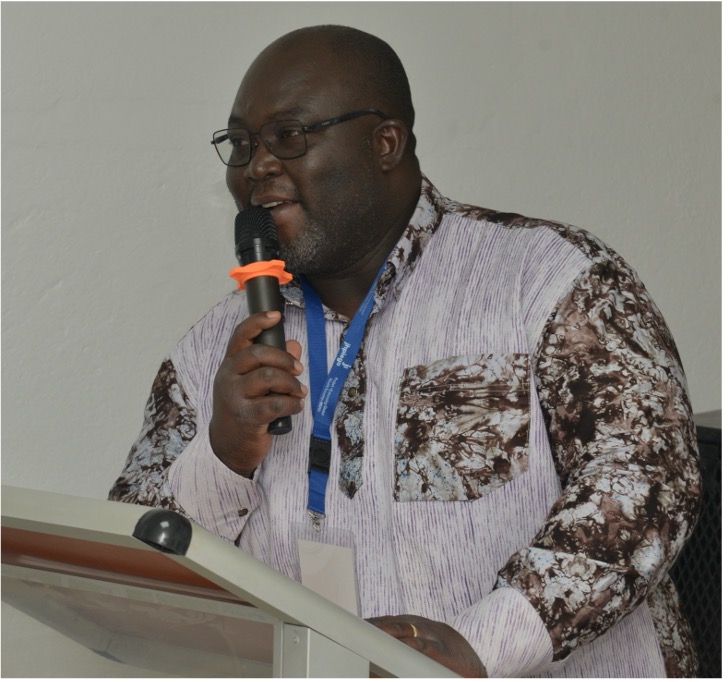
Dr. Franck Obulbiga
Dr. Franck Obulbiga, field epidemiologist and technical advisor in emergency health response operations and vaccination for Jhpiego in Burkina Faso (médecin épidémiologiste de terrain, conseiller technique en charge des opérations d’urgences et de la vaccination à Jhpiego Burkina Faso), described the workshop as an “excellent forum for technical exchange and regional collaboration” *.
“It enabled the creation or strengthening of lasting professional relationships between data managers, epidemiologists and surveillance officers from the five countries,” says Dr. Obulbiga. “The cross-reviews of national bulletins fostered a frank sharing of experiences — highlighting both existing best practices (automation of analyses, integration of laboratory data, performance indicators) and common challenges, including the lack of graphic harmonization and the accuracy of data sources.” *

Dr. Somtinda Christelle Nikiema
Another workshop participant and Division Chief of Integrated Health Emergency Surveillance and Response Division at the Ministry of Health, Public Hygiene, Universal Health Coverage, and Insurance (Chef Division de la surveillance intégrée des urgences sanitaires et de la riposte au Ministère de la Santé, de l’Hygiène Publique, de la Couverture Sanitaire Universelle et des Assurances) in Togo, Dr. Somtinda Christelle Nikiema, believes that the workshop’s impact doesn’t end with the meningitis bulletin SOP.
“Beyond meningitis, this workshop provided an opportunity to share experiences on other aspects of disease surveillance for epidemic potential in different countries and on ongoing epidemics,” states Dr. Nikiema. “The key takeaway is that a spirit of solidarity and regional cooperation enables us to pool knowledge for better achievement of our objectives.” *
After four days of group discussions, template development and code sharing — which involved workshop leaders presenting and offering their statistical models for future reproduction — an SOP that reflects the needs of multiple countries was created. Through the strong engagement and participation of the countries in attendance and the support of the technical partners involved, a community of practice was formed as well.

Photo: EPE Komi Dodzi
What’s next: Looking beyond the workshop
While the workshop finished at the end of March, there is more work to be done.
After participants expressed clear interest in continuing to meet and maintain collaboration, the first follow-up meeting took place on June 4, 2026. With the Jhpiego team coordinating, the meeting offered workshop participants an opportunity to share updates on progress made in implementing the SOP to develop annual meningitis bulletins and to continue to exchange their experiences to learn from one another.
“These activities will help sustain the relationships and momentum built during the workshop while supporting the continued development of a community of practice,” notes Martin.

Photo: EPE Komi Dodzi
While the workshop has concluded and the SOP is finalized and available in both English and French, Dr. Berry and the CVPD’s work continues — including continued support of surveillance strengthening activities in West Africa and epidemiological analyses of bacterial meningitis before and after new vaccine introduction.
“This is something that U of T will continue to support,” explains Dr. Berry. “[This] will become even more important in the context of vaccine rollout where the epidemiology of bacterial meningitis pathogens may change.”
*Please note: Quotes have been translated from the original French into English by the author.